

ADU Financing in Portland: Keep Your Low Rate
For most owners with a low first mortgage, the best ADU financing in Portland is a home equity loan or a HELOC. Both pay for the build and leave that mortgage alone. Cash-out refinances and renovation mortgages replace it. Construction loans pay in draws and usually become a new first mortgage. In 2026, the City of Portland’s ADU SDC waiver is the one live local break; Craft3’s ADU loan and the BackHome pilot are not lending.
You locked in a low rate, and you call that loan “the primary” for a reason. Now you want an ADU out back. Yet most pages on ADU financing in Portland seem to open with a refinance that would throw that rate away.
The other routes look shaky too. HELOC rates move. Some lenders treat an ADU like an exotic project and make you explain everything. And the Portland ADU loan programs people still recommend online have stopped lending.
This guide compares every way to pay for an ADU through two questions. Does it cost you your first mortgage? And what does the lender need from your builder? You’ll leave with a shortlist, the blended-rate math and the paperwork that gets a loan sized right.
ADU financing options in Portland, compared
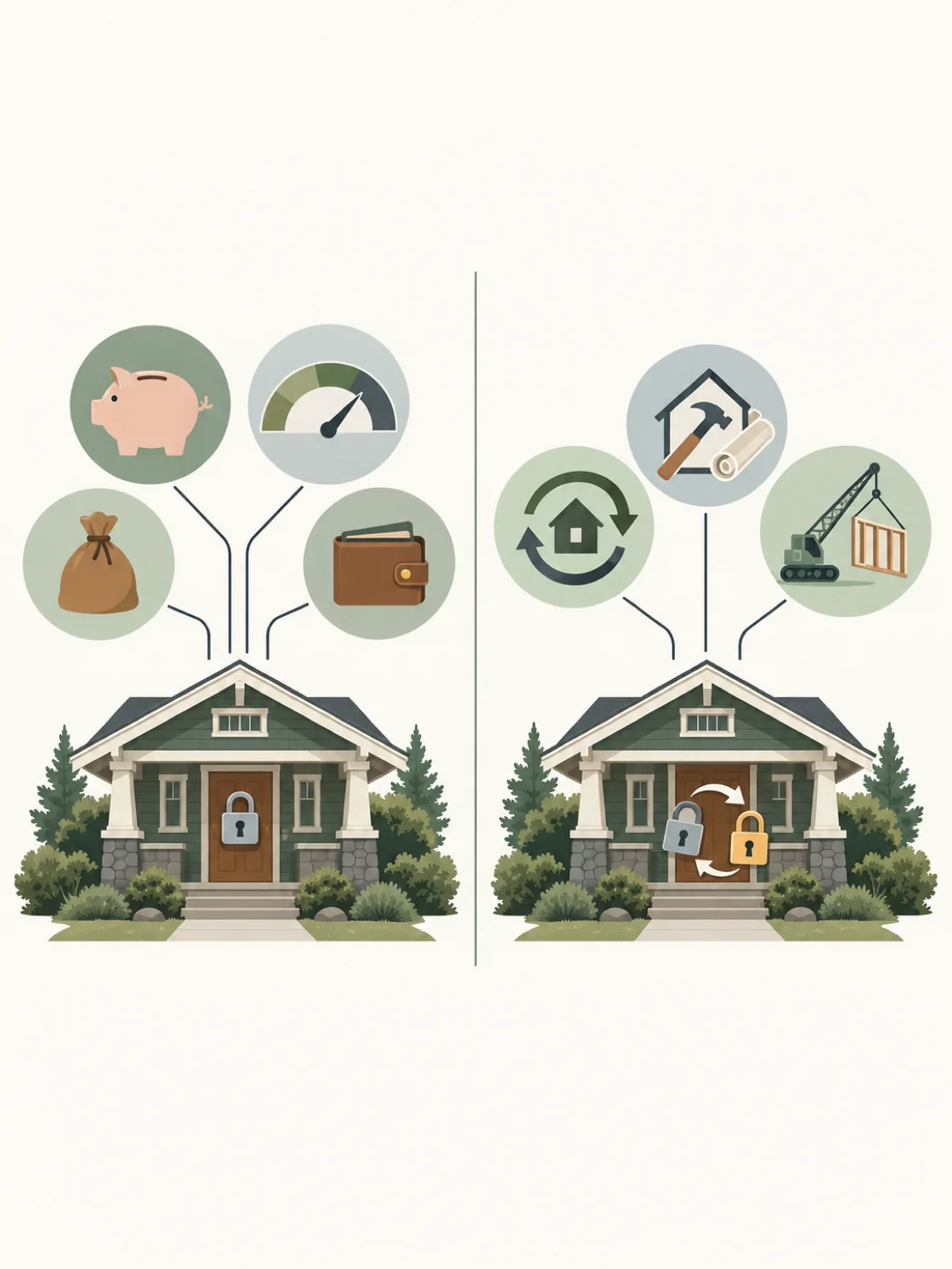
Portland homeowners have seven ADU financing options, and four leave your first mortgage alone: cash, a HELOC, a home equity loan and a personal loan. Cash-out refinances, renovation mortgages and most construction loans replace it.
| Option | Keeps your first mortgage? | Fixed or variable | How it pays out & what the lender needs from your builder | Best for | Watch out |
|---|---|---|---|---|---|
| Cash / savings | Yes | No interest | You pay the builder directly; no lender involved | Small builds, or closing a gap | Drains your emergency cushion |
| HELOC | Yes | Usually variable | You draw as the build moves; the lender asks almost nothing of the builder | Owners who want flexibility | Payment can rise with rates |
| Home equity loan | Yes | Usually fixed | One lump sum at closing; you set the builder’s payment schedule | Owners who want one fixed payment | Interest on the full amount from day one |
| Cash-out refinance | No, replaced | Fixed or adjustable | One payout at closing; little needed from the builder | Owners whose rate is already near today’s | Gives up a low first-mortgage rate |
| Renovation mortgage (HomeStyle, CHOICERenovation, FHA 203(k)) | No, replaced | Fixed or adjustable | Paid out as work is done; contractor bid and documents, plus a HUD consultant for 203(k) Standard | Buyers adding an ADU, or owners with no low rate | The lender reviews your builder and the paperwork |
| Construction-to-permanent loan | Usually replaced | Varies by lender | Draws released after inspections; plans, bid and draw schedule | Large detached builds | Versions that sit behind your mortgage are hard to find |
| Personal loan | Yes | Usually fixed | Lump sum to you; nothing needed from the builder | Small gaps | Shorter term, higher payment |
Other homeowners lean the same way, at least in California. An April 2024 Urban Institute report cites a 2021 UC Berkeley survey of 800+ California homeowners who built a permitted ADU. 62% used liquid assets. Of the 43% who used mortgage products, 56% used a HELOC or home equity loan, 35% a cash-out refinance and only 6% construction or renovation financing.
That is California data, not Portland data, but the pattern matches the table: owners reach first for loans that keep the primary in place. The table assumes you already own the home and have equity. If you’re buying a house to add an ADU, the renovation-mortgage row moves to the top of your list.
Keep your first mortgage: HELOC or home equity loan?

A HELOC and a home equity loan both keep your first mortgage, because each is a second loan that sits behind it. Your low rate stays on the balance you already owe. Only the new money costs today’s rate.
The Consumer Financial Protection Bureau (CFPB) draws the line this way: a home equity loan pays you a lump sum, while a HELOC is a revolving line of credit, usually with an adjustable rate. Both use your house as collateral.
The worry is that a second loan at a higher rate wrecks the math. It usually doesn’t, and the blended rate shows why.
Example, not a quote. Say you owe $300,000 on your first mortgage at 3%. You borrow $150,000 for the ADU on a second loan at 8%. These are round, illustrative numbers, not today’s rates.
Weight each rate by its balance: ($300,000 × 3% + $150,000 × 8%) ÷ $450,000 = about 4.7% blended rate. A cash-out refinance would put all $450,000 at the new rate. If that rate sits above 4.7%, the second loan wins.
Swap in your own balances and rates; the math fits on one line. It ignores differences in loan terms and closing costs, so treat it as a first check, not the final answer.
This route works when you have built up equity. It breaks down if you bought recently or put little down. Lenders cap your combined loan-to-value (LTV), meaning both loans added together and divided by your home’s value. A recent buyer around Alberta or Woodlawn in NE Portland may find too little room under that cap.
HELOC: a credit line with a rate that moves
A HELOC for an ADU build works like a credit line secured by your house. You draw as the foundation, framing and finishes come due, and you pay interest only on what you’ve used. That keeps early payments small while the project ramps up.
The catch is the rate: when it moves up, your payment moves up too. A HELOC fits owners who want flexibility and could absorb a higher payment for a few years, even if rates climb before the ADU earns rent.
Home equity loan: one lump sum, one fixed payment
A home equity loan to build an ADU fixes your cost from the first day. You get one lump sum and one fixed payment you can plan rent or a household budget around.
The trade-off is timing. You pay interest on the whole amount from day one, even while part of the money waits for the next build stage. Owners who value certainty pick this “fixed rate second” anyway, because it gives them the one thing a HELOC can’t: a number that never changes.
Which one to pick: choose the HELOC if the build pays out in stages over months and your budget can take a higher payment. Choose the home equity loan if the ADU payment has to fit a fixed budget or future rent.
When a cash-out refinance still makes sense
Your first mortgage: replaced.
What the lender needs from your builder: little; the lender appraises your home and pays you at closing.
A cash-out refinance swaps your current mortgage for a larger one and pays you the difference in cash, as the CFPB’s guide to using home equity explains. Every dollar you already owe moves to the new rate.
The deciding check is your current rate versus today’s rate for a new mortgage. If they’re close, or your remaining balance is small, one loan and one payment can be simpler than two. If you hold a 2 to 3% loan, cash-out rarely pencils out, because you’d reprice the whole balance to fund one backyard project.
ADU construction loans: draws, and usually a new first mortgage
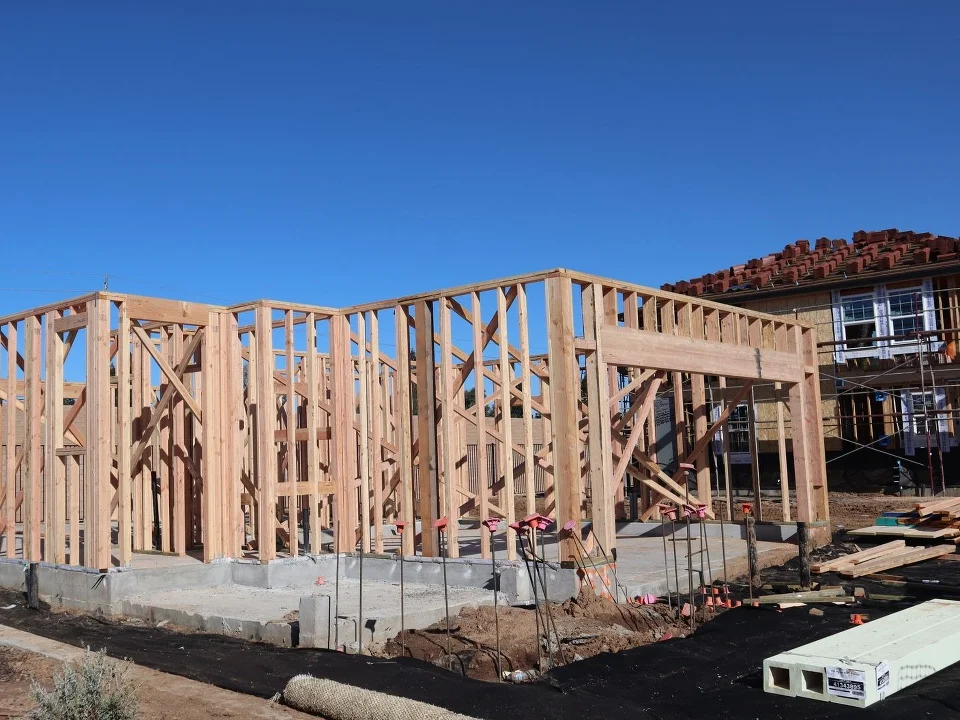
Your first mortgage: usually replaced.
What the lender needs from your builder: a draw schedule tied to inspections, so money is released only as each stage passes.
ADU construction loans are usually construction-to-permanent loans. The lender pays the build in stages, releasing each draw after an inspection. When the ADU is finished, the loan converts into a long-term mortgage.
Is it hard to get a loan to build? Harder than a HELOC, mostly because of where the loan sits. A construction loan in second position, behind the mortgage you already have, is hard to find. Most lenders want to be first in line, so this path usually means folding your existing mortgage into the new loan.
Expect the lender to underwrite the project and the builder, not only you.
A construction loan to build an ADU makes the most sense for a large detached unit whose budget runs past your equity. That’s the scale of project JAM builds as a Portland ADU contractor, from permits to final inspection. For a small garage or basement conversion, the extra paperwork and closing steps rarely justify it.
Renovation mortgages: HomeStyle, CHOICERenovation and FHA 203(k)
Your first mortgage: replaced.
What the lender needs from your builder: a contractor bid and documents, plus a HUD consultant on an FHA 203(k) Standard loan.
A renovation mortgage rolls a purchase or refinance and the cost of the work into one first mortgage. Three versions exist: Fannie Mae HomeStyle Renovation, Freddie Mac CHOICERenovation and FHA 203(k), which HUD offers in Standard and Limited types.
If you searched for a Fannie Mae ADU construction loan, HomeStyle is the product to ask about; confirm with the lender that your ADU plan fits its rules. These loans are strongest when you’re buying a house and adding an ADU in the same loan, or when you have no low rate to protect. If you hold a 2 to 3% mortgage, they replace it, so a second loan usually wins.
Cash, savings and personal loans: for small gaps
Your first mortgage: not touched.
What the lender needs from your builder: nothing; you pay the builder directly.
Cash is the simplest way to pay for an ADU: no interest, no appraisal and no lender reviewing your builder. The trade-off is liquidity. Money tied up in an ADU’s walls can’t cover a job loss or a roof leak next winter.
A personal loan is unsecured, so your house isn’t the collateral. Terms run shorter than home-secured loans, and payments run higher. That makes it a tool to close a gap, such as a finish upgrade or a surprise cost, not to fund a whole build.
Mixing in cash works when it keeps your second loan smaller without emptying your reserves. If paying cash would leave you with no cushion, borrow a little more instead.
Portland ADU loan programs and the SDC waiver: what’s live in 2026
The Craft3 / BackHome ADU loan was Portland’s public second-position ADU construction loan, able to sit behind your existing mortgage, according to the BackHome FAQ. It is not available now, so Portland has no public second-position ADU loan program today. Craft3 discontinued its general ADU loan in 2024, according to a Federal Reserve Bank of San Francisco research brief.
The BackHome ADU pilot served Multnomah, Clackamas and Washington counties and produced 30 ADUs. It is paused while it seeks capital, and it keeps a waiting list. Its loans required renting the ADU to a household at or below 80% of area median income for 8 years.
The one live local break is the Portland ADU SDC waiver. It waives system development charges (SDCs), the one-time fees new construction pays toward city infrastructure, on a new ADU that is owner-occupied or rented month-to-month or longer. In return, you accept a 10-year no-short-term-rental covenant on the ADU and the house.
Two limits matter. The City’s temporary SDC exemption for new housing, for permits issued August 15, 2025 to September 30, 2028, does not cover ADUs. And the waiver applies only to City of Portland permits, so owners in Beaverton, Tigard, Milwaukie or Oregon City pay their own city’s charges.
What the lender needs from your ADU builder

Beyond your credit and equity, most ADU loan requirements land on your builder: a fixed-scope bid, permit-ready plans and a draw schedule. HELOC and home equity lenders ask for almost none of it; construction and renovation lenders want all three before they size the loan.
A fixed-scope bid, permit-ready plans and a draw schedule
On a HELOC or home equity loan, the lender won’t ask for any of this, yet the bid still does the most work for you. It sets the size of the line you request under the combined loan-to-value cap, before the design is final. Borrow from a real number and a mid-build overrun won’t force a second loan.
Construction and renovation lenders size the loan from your builder’s numbers. A loose estimate makes the lender size the loan too low, or stall until better numbers arrive.
- Fixed-scope bid: every line priced, from foundation and utility hookups to finishes, so the underwriter matches the loan to a real number instead of guessing at allowances.
- Permit-ready plans: drawings ready for Portland Permitting & Development, so the lender isn’t funding a design that could change after plan review.
- Draw schedule: payments tied to stages an inspector can sign off, so money moves when work is done and your budget never runs ahead of the build.
A vague range costs you either way. A smaller loan forces cash into a gap you didn’t plan for, and a stalled one costs you weeks.
JAM Concept Remodeling hands the lender that package. JAM is a licensed, bonded and insured general contractor (CCB# 202777) with 25+ years in residential construction. The owner supervises the build directly and works with engineers and city inspectors, so each draw stage matches what passes inspection. You walk into the lender’s office with numbers it can underwrite, even if it has never financed an ADU before.
Can future ADU rent help you qualify?
Usually not for an ADU you haven’t built yet. Under Fannie Mae’s Selling Guide rule B3-3.8-02, rent counts only from one ADU that already exists, only on a purchase or limited cash-out refinance, and it is capped at 30% of total qualifying income.
HELOC and home equity lenders set their own rules, so ask before you count on future rent. When you’re ready to price the project itself, start with JAM’s ADU building service.
Pick your ADU financing in four steps
The best way to finance an ADU starts with the project price, not the loan. Get an early scope price, check your equity and rate, shortlist two options, then quote lenders with your builder’s final package in hand.
- Get an early scope price. Include design, permits, utility connections, the build and a contingency, so you borrow once instead of twice.
- Check your equity and your current rate. Equity sets how big a second loan can get; your rate tells you whether replacing the first mortgage could ever pay off.
- Pick two options from the comparison table. For most owners with a low rate, that means a HELOC and a home equity loan.
- Get the fixed-scope bid on permit-ready plans, plus a draw schedule, then quote two or three lenders. One package lets every lender price the same project.
If the budget runs past your equity, two paths stay open: a construction loan, or a smaller project. A garage or basement conversion reuses a structure you already own, which can bring the ADU back inside the equity you have.
ADU financing in Portland: keep the primary, build the ADU
ADU financing in Portland comes down to keeping the rate you already have. For most owners, a HELOC or a fixed home equity loan funds the build and leaves the primary alone, while a fixed-scope bid, permit-ready plans and a draw schedule get the loan sized right the first time.
The questions below come up once you’ve picked a financing path.
Frequently asked questions
Can I get a loan to build an ADU?
Yes, homeowners with enough equity can get a loan to build an ADU. The hard one to find is a construction loan that sits behind your existing mortgage, so ask about that early.
Is it worth giving up a 3% mortgage to build an ADU?
Usually not, because a second loan can fund the ADU and keep that rate. Your 3% stays on the existing balance, and only the new money costs more. Weight the two rates by their balances to get your blended rate. If it beats a full refinance, keep the primary.
When should I line up financing in the ADU timeline?
Line up financing before final design. Learn your borrowing room from an early scope price, then finish the design inside that number. Construction and renovation lenders then need the final bid and plans. That order keeps you from designing an ADU you can’t fund.
Will my lender understand an ADU project?
On a HELOC or home equity loan, it doesn’t need to: the lender looks at your equity and income, not the project. On a construction or renovation loan, the fixed-scope bid, permit-ready plans and draw schedule are what make an ADU legible to an underwriter who has never financed one.
Will an ADU raise my property taxes in Portland?
Yes, but only the ADU’s added value enters your assessed value. Under Oregon’s Measure 50 system, new construction adds to your maximum assessed value without a full reset, per the Oregon Department of Revenue manual. Multnomah County treats new construction over $18,700 in one year as an exception event.
Is there an ADU grant in Oregon?
We found no Oregon state or Portland-area ADU grant for homeowners as of November 2026. The “$25,000” figure that circulates matches Washington County’s home-repair loan, which is a loan, not a grant, and not for ADUs. Portland’s ADU SDC waiver cuts fees but pays no cash.
Is the Craft3 ADU loan still available?
No, Craft3 discontinued its ADU loan in 2024, per a Federal Reserve Bank of San Francisco brief, and the BackHome pilot is paused.
Can I rent the ADU on Airbnb if I take the SDC waiver?
No, the waiver’s covenant bars short-term rentals for 10 years. It covers the ADU and the main house, and it is notarized and recorded with Multnomah County. Breaking it costs 150% of the current SDC fees, per the City of Portland. Renting month-to-month or longer still qualifies.
Still have questions? These come up often too:
- What should an ADU bid include for a lender?
- How long does ADU loan approval take?
- Are there fees besides the loan, such as permits, SDCs and recording the covenant?
- How much contingency should the loan include?
Each depends on your lot and your lender. Send JAM your questions and get answers for your project.

Leave a Reply
Want to join the discussion?Feel free to contribute!